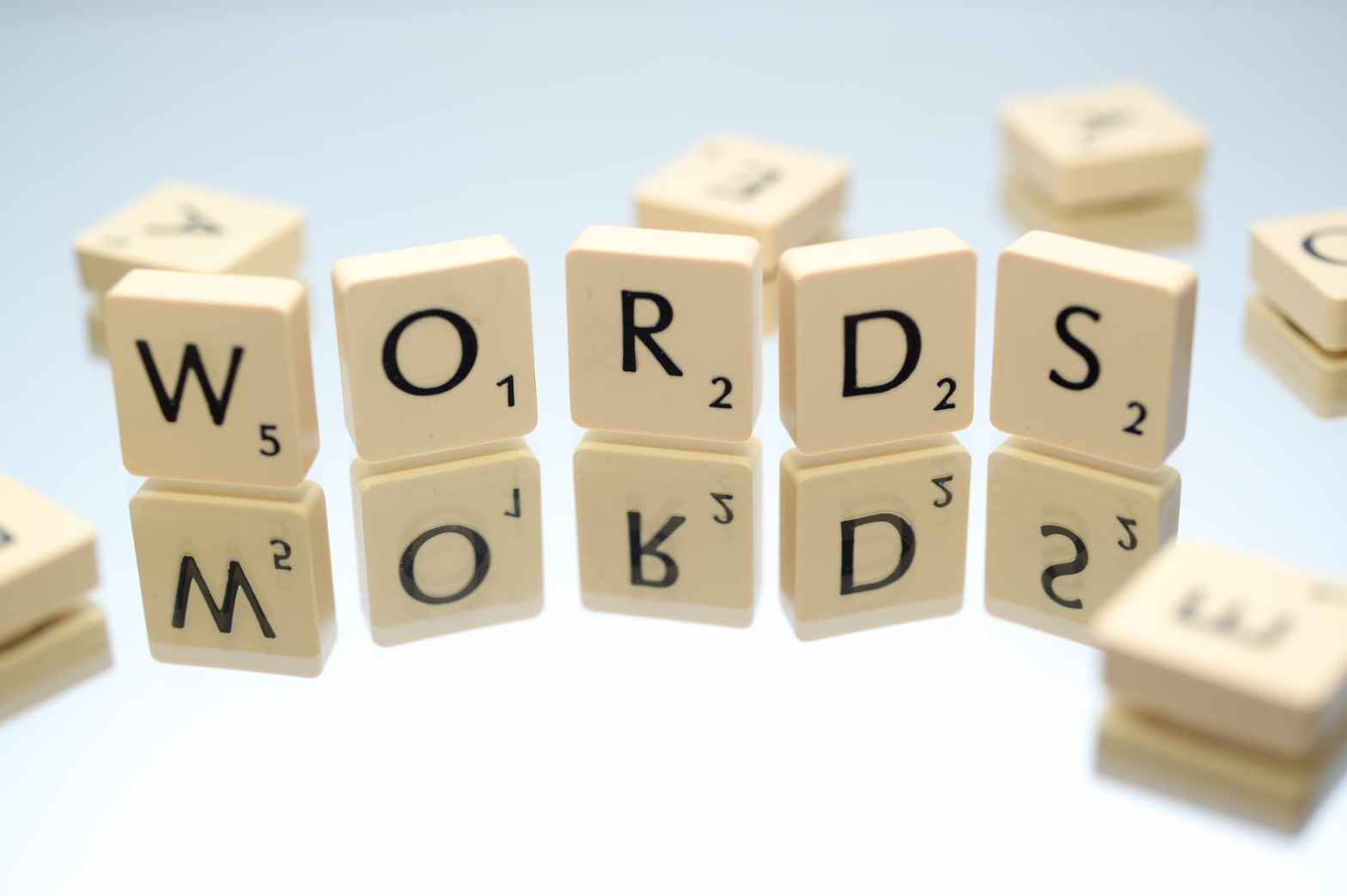
Lots of people select a word to focus on at the beginning of a new year. Google “word for the year,” and you’ll find nearly three billion entries to chase down — offering reasons for doing so, tips for how to choose one, and lists of possible words. I had never chosen a word for the year before, but I found the word “voice” swimming up to the top of my consciousness as I reflected on the year at the close of 2020, and that’s my word for 2021.
The appeal of this to people, I think, is that it provides a focus, a sense of purpose and intention. At its root, the word intention means to pull taut, to stretch out or to strain towards. In choosing a word for the year, I’m telling myself to live this year with intention — drawing the string of days taut with a theme rather than letting them bounce around aimlessly in the drawer marked “2021.”
The appeal of this to me is, well… words. Words fascinate me with their rich histories, and I love digging into their roots. As the containers for our thoughts and ideas, words can wound or heal, incite riots or bring peace, mend relational fences, tear down interpersonal walls, raise or destroy reputations and effect positive change… to mention only a few of the ways they impact our experience as human beings. From the beginning, we teach our children to “use your words” to express themselves, rather than lashing out and resorting to hitting and throwing. Words make our relationships possible, and we use our voices to make them happen.
I found 26 meanings listed under the word voice in the dictionary, and while it can mean the vehicle or agent used for the transmission of speech (a noun), for my purposes, I’m also thinking about it as a verb: the action of giving utterance or expression to a thought or idea — to declare or proclaim. To give voice. The distinction was made between vocalizations made with intention, versus those made involuntarily, as when one spies a mouse in one’s kitchen.
The word “voice” usually implies sound — a noise that can be heard, suggesting that it results in something being received by another. The one using her voice doesn’t control the outcome of what is expressed, only its utterance. Plutarch defined it as “that which brings light upon that which is thought in the mind.” The voice may be soft or loud, lowing or bleating. Its opposite is silence.
“When the whole world is silent, even one voice is powerful” (https://www.amazon.com/Am-Malala-Stood-Education-Taliban-ebook/dp/B00CH3DBNQ). When one voice is lifted, silence is… silenced. Becoming the youngest person to ever receive the Nobel Peace Prize, at age 17, Malala Yousafzai survived an assassination attempt by the Taliban (at the age of 14) and continues to use her voice on behalf of girls and their rights to have freedom and education in Pakistan and around the world. A single candle eliminates the pitch black of darkness, and there is light.
Not all voices are audible. I recall conversations I had years ago with the counselor I was seeing at the time of my separation & divorce. The Bible verses I kept in mind throughout that very painful process were Hebrews 10:23, “Let us hold unswervingly to the hope we profess, for He who promised is faithful,” and Philippians 1:27, “Conduct yourselves in a manner worthy of the gospel of Christ.” Profession and conduct… my speech and my actions. I wasn’t always pleased with what went on in my head and made its way into my behavior.
Sarah helped me to develop the practice of identifying who was “on stage” in my mind as I faced stressful situations, which not only strengthened my ability to manage how I “showed up” in my life, but helped me to disassociate myself from the harsher voices in my head. She helped me to stop thinking of myself as a Perfectionist, suggesting that I think of myself, rather, as having a relationship with perfection. That small shift enabled me to have greater capacity for kindness –for myself, and others.
Recently, this dovetailed nicely with my learning about the Enneagram (Ennea is the Greek word for 9, and the Enneagram is a method of identifying 9 personality types), and finding that… surprise, surprise…. I am a Type 1: The Perfectionist (they evidently haven’t heard it’s not nice to assign labels like that). The book I read (https://www.amazon.com/Road-Back-You-Enneagram-Self-Discovery/dp/0830846190) made the point that it may be helpful to name the inner critic that tries to rule the roost in my head, and rather than try to silence her, to befriend her.
I had done that years ago (I won’t tell you her name, but Faye Dunaway played her in the 1981 made-for-television movie). Trying to silence her voice won’t make her disappear; rather, I have tried to make space for her, to find her a chair, without giving her the microphone.
Some voices show up in print. The voice that made its debut in 2020 is the one that shows up here, and I’m continuing to figure out what it has to communicate. As a singer, I have had the honor of testifying about God’s goodness, faithfulness and love and praising His name using others’ words. In this space, I’m using my words, and hope to do much the same thing. But just because anyone can produce a blog nowadays doesn’t mean it’s worth reading. For it to have meaning, the voice has to be tied to a message that matters, which brings one back to intent. To purpose. To what am I straining toward with these words on a page?
In 2021, I’ll be exploring my voice. A card caught my attention at a store recently. It “spoke” to me and I hope it will provide me with direction as I write.
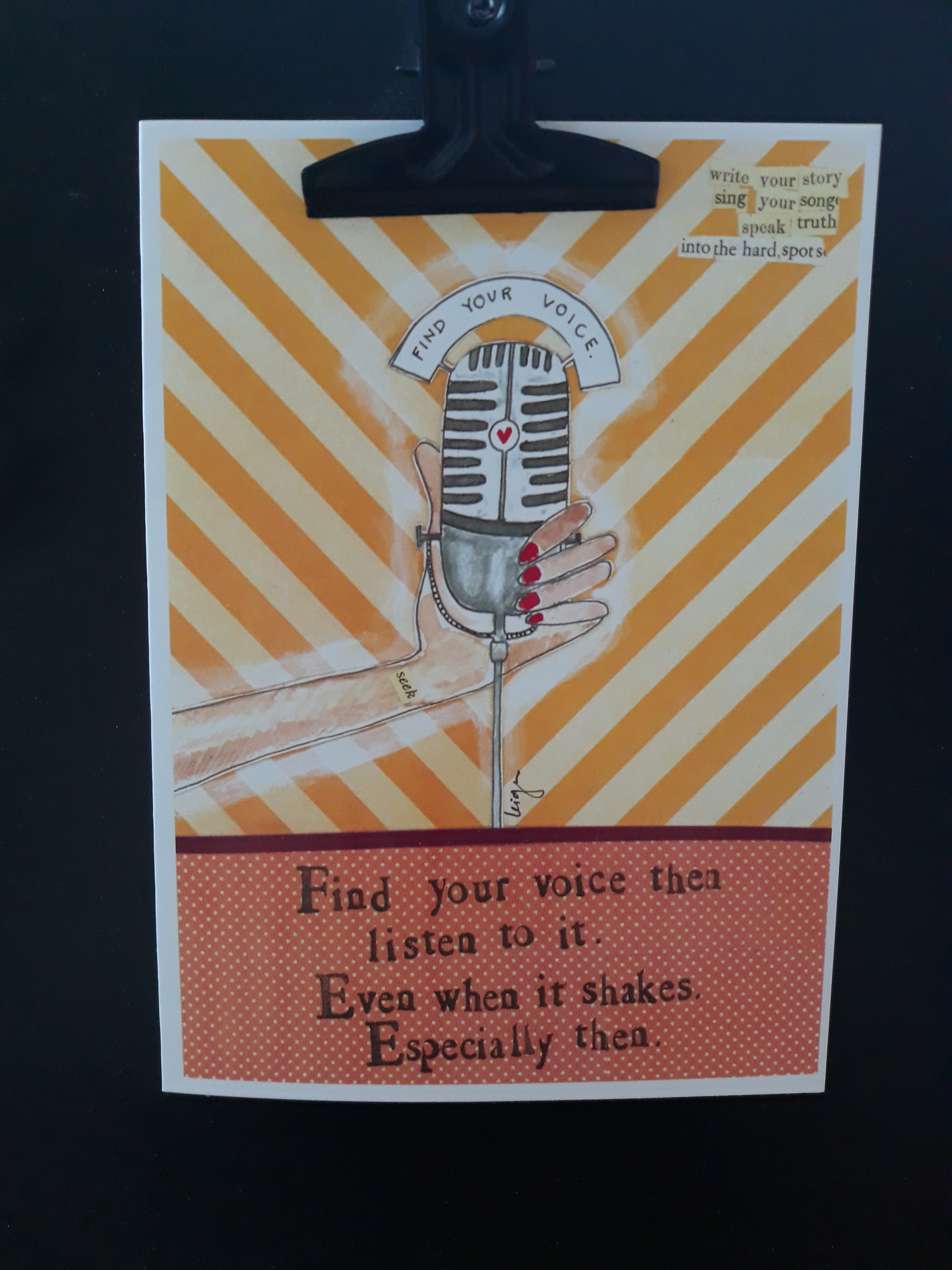
This space shouldn’t be all about me. As I review what I’ve posted, I see that it’s been all about me. Maybe part of focusing on voice this year will be about giving voice to something other than me. Likely, it will be about becoming more attuned to God’s voice, which has been a lifelong pursuit. As I head out into 2021, which has already seen a clash of words — and more — in this country, Psalm 19:14 comes to mind as wisdom to take with me: “May the words of my mouth and the meditation of my heart be acceptable in your sight, O Lord, my rock and my redeemer.”
Using your words can be scary, and it doesn’t always mean things will turn out well. I remember thinking “he used his words” when I first saw the news report of what happened to George Floyd in my home town of Minneapolis on May 25th, 2020. His words were, unconscionably, unheeded in the moment, but his voice has echoed far beyond Minnesota and the United States of America. Malala Yousafzai’s voice would not be silenced in Pakistan, and she is still heard around the world. I don’t aspire to having impact worldwide, but I think my purpose is the same: to lift my voice, to pull the string of my words taut and to let them go, landing where they may.
 Karna Eastlund Haugen