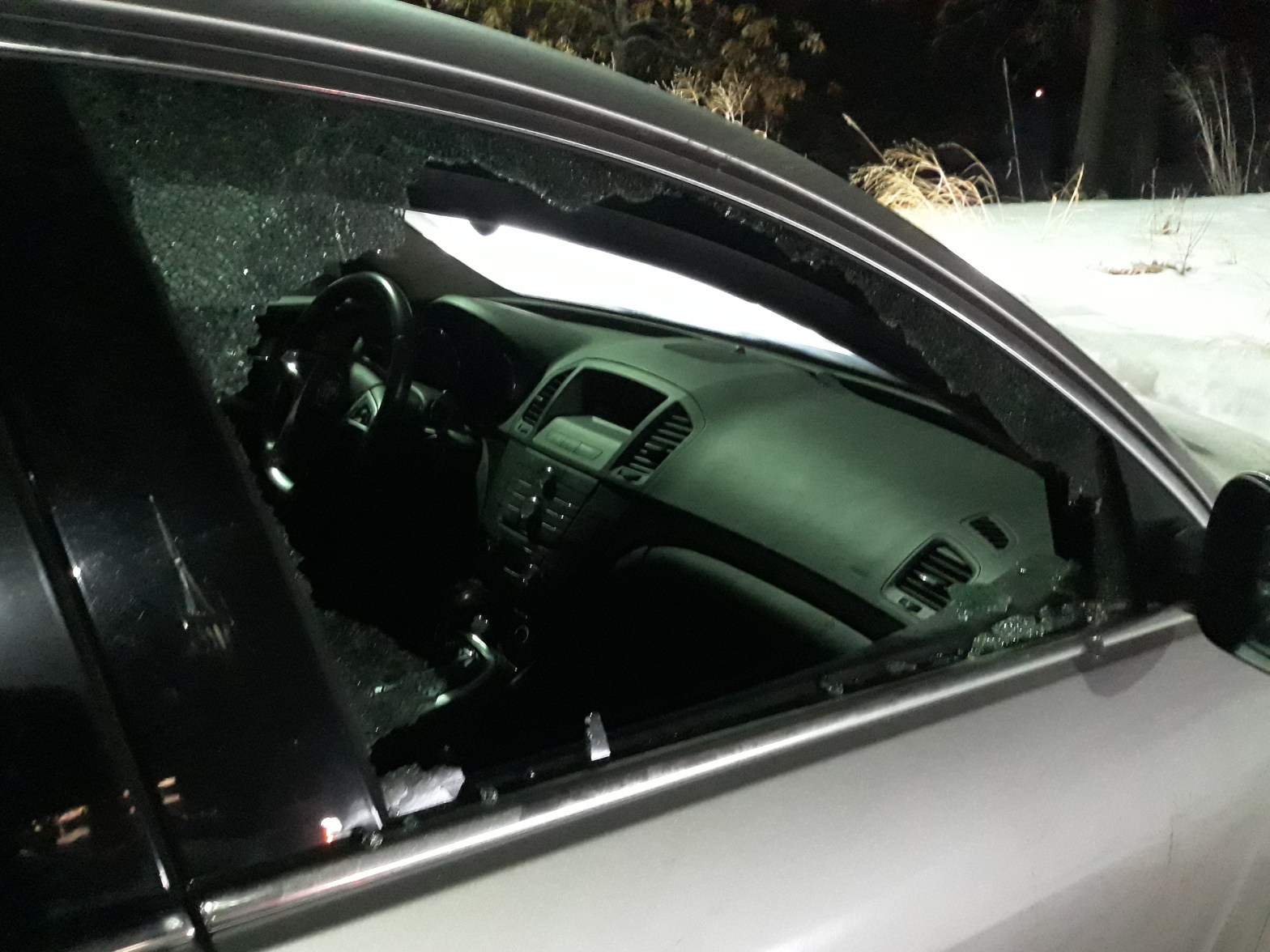
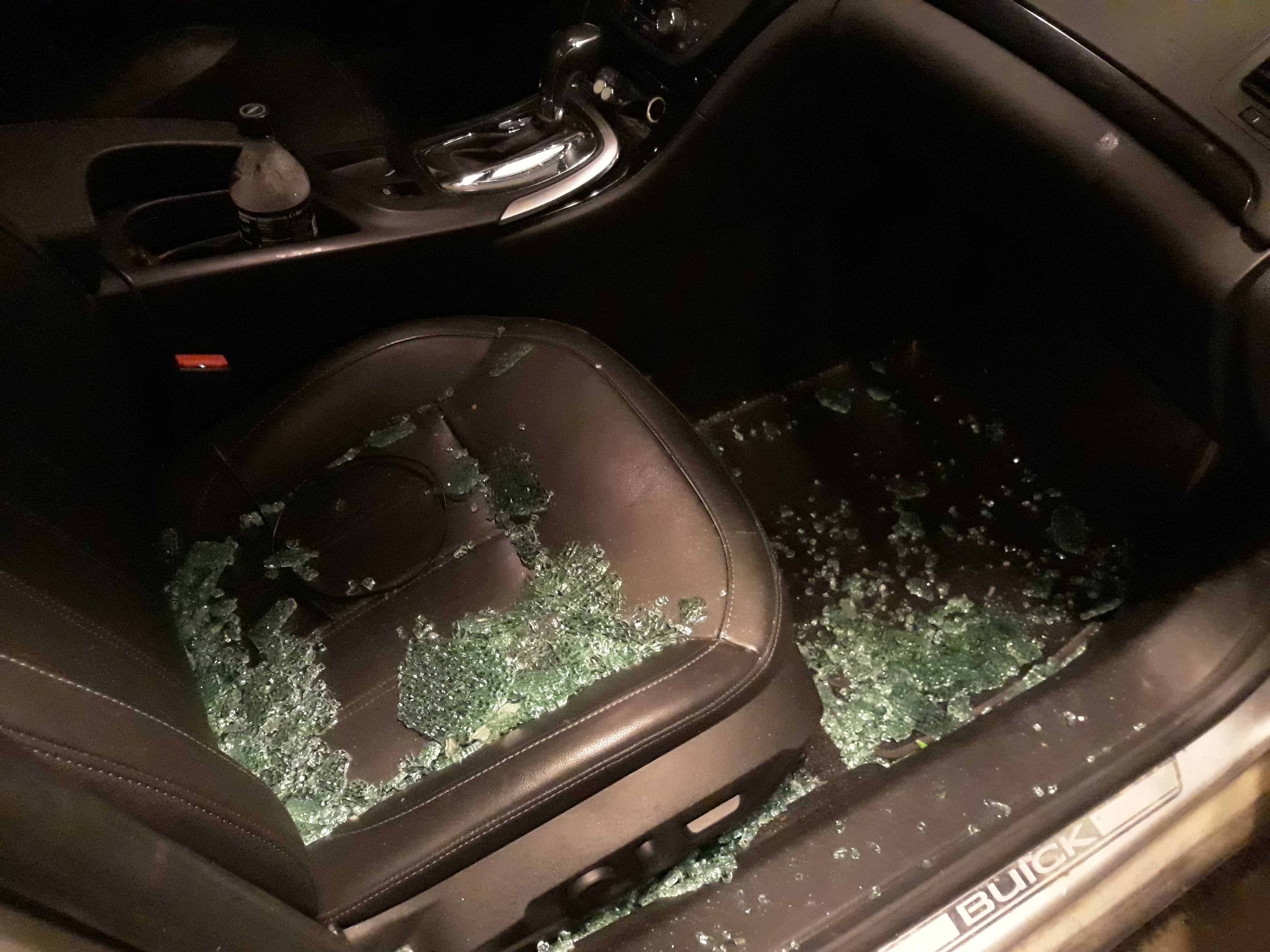
I recently had to have the front passenger-side window of my car replaced. I had come back to my car one evening after choir rehearsal to find it shattered. Mine was among five cars in the church parking lot that were broken into, and it took me a few seconds to realize what I was looking at. The miscreants not only broke the window, they also took some valuable-to-me items from the front seat (which is why one shouldn’t leave items in plain view in one’s car. GRRRRRR. Lesson learned). I found myself grappling with very bitter feelings about human beings, generally, for several days afterwards. Turns out I can really dislike people.
But it reminded me of something I had recently read about brokenness in Life of the Beloved, by Henri Nouwen. In the scope of his book about being the Beloved of God, he advised two things in coping with our personal version of brokenness: befriend it and put it under the blessing of God. “We have to find the courage to embrace our own brokenness… to claim it as an intimate companion (and) put it under the light of the blessing… Pain lived under the blessing is experienced in ways radically different from… pain lived under the curse. …What seemed a reason for depression becomes a source of purification. What seemed punishment becomes a gentle pruning. What seemed rejection becomes a way to deeper communion.”
As I relayed my dismay to my insurance agent, Greg, he shared a story from his life that is almost beyond belief in its scope of improbable mishaps that lined up for him. In Europe during the summer before he was to begin his senior year of college in 1982, he and the group of friends he was traveling with (including his future wife, Dawn, and his sister, Shelly) decided to spend their next-to-last-day at the beach in Nice, France. They left their belongings at the train station, and he put his backpack containing travelers’ checks, his passport, his return airline ticket, rolls of film, and other items in a coin-operated locker so all he had to keep track of was his train pass and the key to the locker for his day at the beach.
They timed their return to the station shortly before the train was to depart, taking them back on a night train toward London. As he opened the locker, he found it empty. They quickly realized he couldn’t hope to leave France / enter England without a passport, so had to make their way to the American embassy in Paris. When they arrived the next day at the embassy, they found a sign stating that due to the American holiday (Labor Day), the embassy was closed.
He spotted a guard and was able to communicate his need enough to be allowed inside to connect with the embassy staff who were on duty for cases of emergencies. There was one other American inside who was also seeking assistance. The only identification Greg had was his train pass and his friend who testified he was who he claimed to be. The staff reluctantly agreed to complete the required paperwork to issue him a new passport, but explained that he would need to provide a photo. Giving him the address of a photo booth nearby, they told him he had to be back by 3:00 PM. The other stranded American gave him seven francs, as Greg had zero cash.
Winding his way through foreign streets at a frantic pace, he found the photo booth that the helpful American had used, but a technician had just begun repair work on it so Greg had to run through the streets of Paris to locate another photo booth. Finding one, he had some pictures taken with the precious seven francs, and then sprinted back to the US Embassy in time to get his emergency passport so they could get back to London by the next day to catch their flight back to the US.
Once back in London, he learned that the airline had issued a new ticket for every passenger for some mysterious reason, so he was able to get back to America, with just the clothes on his back, with no further obstacles. He doesn’t know how or why, but about nine months later he received a manilla envelope with a New York postmark in the mail, which contained his original lost passport. No note was included, so to this day he has no idea how or why someone returned it.
As he was recounting all of this to me, he noted that “even at the time, I realized that it was probably good that it happened to me rather than one of the others because I was probably the one best able to handle it.”




Having that capacity for perspective even in the moment probably helped him to better cope with it. With hindsight, what felt like an insurmountable catastrophe to his 21-year-old self has become an old-timey anecdote (travelers’ checks? film?) he can share with panicky insurance clients.
So how do we befriend brokenness? I once read or heard a story about how, if every human hardship, burden or heartache on earth was thrown into an enormous pile and we each had to choose one, the likelihood of our picking up something other than the one we had set down — the burden that we are familiar with, have absorbed and carried — is low. That, if given the choice, we would most likely… perhaps silently fretting, but willingly… take back the very one we had added to the pile. The point in the story was that if only because we can’t imagine the long-term ramifications of other burdens and are therefore unwilling to choose them, we somehow own our personal troubles. At the end of the day, we recognize that others’ hardships are just as difficult if not more so.
But our usual tendency is not to compare our troubles to others, but to look at the apparent ease with which others seem to live their lives. Comparison really is the thief of joy, and whenever I succumb to “why me” thinking in my life, it isn’t helpful. What is comforting is realizing that life on this earth is fraught with trouble. I am not alone in experiencing hardships, burdens and heartache, and Jesus meets me right there.
Cars are broken into. Stuff is stolen. In the grand scheme of things, we know those are just nuisances. Businesses fail. People become sick. Miscarriages happen. Everyone deals with something. Everyone has shattered glass in their lives. Unlike the temporary setbacks of broken car windows and stolen backpacks, much of what occurs is genuinely heartbreaking and tragic.
“So the great task becomes that of allowing the blessing (the knowledge of our Belovedness to God) to touch us in our brokenness. Then our brokenness will gradually come to be seen as an opening toward the full acceptance of ourselves as the Beloved. This explains why true joy can be experienced in the midst of great suffering. It is the joy of being disciplined, purified and pruned. …Here, joy and sorrow are no longer each other’s opposites, but have become the two sides of the same desire to grow into the fullness of the Beloved.”
What brought this chapter from Nouwen’s book to mind as I swept out and vacuumed up the honeycombed glass was this:
“As I write… now about our brokenness, I recall a scene from Leonard Bernstein’s Mass (written in memory of JFK) that embodied for me the thought of brokenness put under the blessing. Toward the end of this work the priest, richly dressed in splendid liturgical vestments, is lifted up by his people. He towers high above the adoring crowd, carrying in his hands a glass chalice.
Suddenly the human pyramid collapses, and the priest comes tumbling down. His vestments are ripped off, and his glass chalice falls to the ground and is shattered. As he walks slowly through the debris of his former glory — barefoot, wearing only blue jeans and a T-shirt — children’s voices are heard singing ‘Laude, laude, laude’ — ‘Praise, praise, praise.’ Suddenly the priest notices the broken chalice. he looks at it for a long time and then, haltingly, he says, “I never realized that broken glass could shine so brightly.”
“The deep truth is that our human suffering need not be an obstacle to the joy and peace we so desire, but can become, instead, the means to it.”
Life of the Beloved, Henri Nouwen
Nouwen’s point, in Life of the Beloved, is that we who call ourselves Christians are, like the bread at the feeding of the 5,000 and at the Last Supper, Taken (or Chosen), Blessed, and Broken to be Given. Taking the whole of Nouwen’s book into consideration serves to quell my uncharitable thoughts about people, if I quiet myself enough to listen. “We are sent into this world for a short time to say — through the joys and pains of our clock-time — the great ‘Yes’ to the love that has been given to us and in so doing return to the One who sent us with the ‘Yes’ engraved on our hearts.“
And there will be some broken glass to sweep up along the way.
 Karna Eastlund Haugen
Once again, you are “right on” with your comments. Yes, we all have broken glass in our lives.