
I am glad I read two novels written by Diane Setterfield, although I’m not sure I can say I genuinely liked or enjoyed them. She is a very good writer, and excels at interspersing thought-provoking and intriguing ideas within the stories she weaves. In the two books, Once Upon a River & The Thirteenth Tale, she creates fairy-tale-esque settings with mystical characters and occurrences, and there are mysteries to be unraveled in both. While there are also gruesome, unsavory elements in each, she doesn’t overly dwell on them or provide explicit details (being more of the Mayberry RFD-kind of reader than CSI: Miami, I sometimes wonder at the need for such glimpses of the underbelly of humanity, but realize that just reflects my preferences).
In Once Upon a River, pubgoers revel in collecting words and telling stories in the 1880s along the River Thames. “They were collectors of words the same way so many of the gravel diggers were collectors of fossils. They kept an ear constantly alert for them, the rare, the unusual, the unique. ‘I reckon I was dumfounded.’ They tried it out for flavor, weighing it on their tongues. It was good. They gave their colleague admiring nods.”
Sometimes, their stories get away from them. “Fred began to feel left out of his own tale, sensed it slipping from his grasp and altering in ways he hadn’t anticipated. It was like a living thing that he had caught but not trained; now it had slipped the leash and was anybody’s.”
And, in the end, sometimes their words fail utterly. “Sometimes they both lapsed into silence and they stared at each other, lost for words…. (their) daughter’s absence had… flooded them both, and… with their words they were trying to bail themselves out. But the words were eggcups, and what they were describing was an ocean of absence, too vast to be contained in such modest vessels.”
In The Thirteenth Tale, the narrator is a bookseller’s daughter & amateur writer whose small work has caught the eye of a celebrated author who asks her to write her biography. While the story that unfolds is a gripping tale, I’m more interested in preserving passages I especially found golden:
On the magic of ink on paper: “My real work is in the bookshop. My job is not to sell the books — my father does that — but to look after them. Every so often I take out a volume and read a page or two. After all, reading is looking after in a manner of speaking… My charges are dear to me, even if, as often as not, they are as dull on the inside as on the outside. No matter how banal the contents, there is always something that touches me. For someone now dead once thought these words significant enough to write them down. People disappear when they die… all living memory of them ceases… yet for some there is an exception to this annihilation. For in the books they write they continue to exist. We can rediscover them… Through the written word they can anger you or make you happy. They can comfort you. They can perplex you. They can alter you. All this, even though they are dead. Like flies in amber, like corpses frozen in ice, that which according to the laws of nature should pass away is, by the miracle of ink on paper, preserved. It is a kind of magic.”
On reading as a child: “I can not pretend that the reading I have done in my adult years matches in its impact on my soul the reading I did as a child…. I still forget myself when I am in the middle of a good book. Yet it is not the same…When I was a child, books were everything. And so there is in me, always, a nostalgic yearning for the lost pleasure of books.”
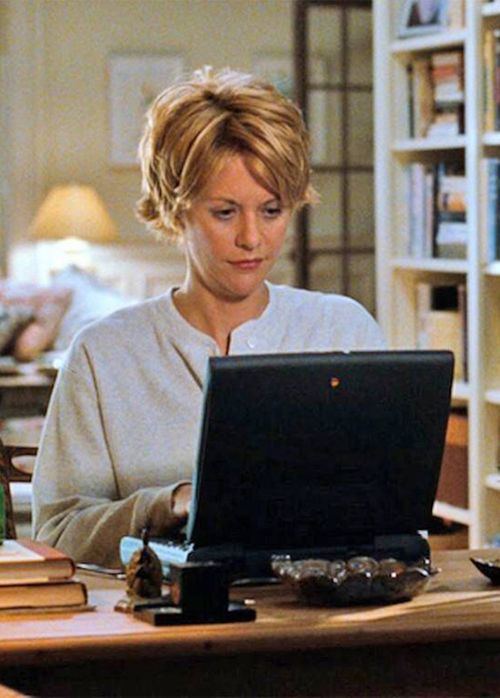
Or, to quote one of my favorites…
“When you read a book as a child, it becomes a part of your identity in a way that no other reading in your whole life does.”
Kathleen Kelly to Joe Fox in You’ve Got Mail
On life as compost: “All my life and all my experiences, the events that have befallen me, the people I have known, all my memories, dreams, fantasies, everything I have ever read, all of that has been chucked onto the compost heap, where over time it has rotted down to a dark, rich, organic mulch. The process of cellular breakdown makes it unrecognizabe. Other people call it the imagination. I think of it as a compost heap. Every so often I take an idea, plant it in the compost, and wait. It feeds on that black stuff that used to be a life, takes its energy for its own. It germinates. Takes root. Produces shoots. And so on and so forth, until one fine day I have a story, or a novel… The writer’s life needs time to rot away before it can be used to nourish a work of fiction. It must be allowed to decay… To write my books I needed my past left in peace, for time to do its work.”
On leaving a book behind: “Do you know the feeling when you start reading a new book before the membrane of the last one has had time to close behind you? You leave the previous book with ideas and themes — characters even — caught in the fibers of your clothes, and when you open the new book, they are still with you… All morning I had struggled with the sensation of stray wisps of one world seeping through the cracks of another.”
While I wasn’t especially enamored with either of these stories themselves, I found the author’s musings about words, books, reading, stories and life itself to make them well worth the read. And sometimes, that’s enough. Have you read a book you didn’t like that you’re still glad you read?
 Karna Eastlund Haugen
I didn’t much care for “ Once Upon A River” either. However, it is clear that when you closed the book the power of storytelling and listening to story affirmed something you value. For you, too, dear author are a lover and collector of words – ..,”the rare, the unusual, the unique.”
I love reading what you wrote and listening to what you have to say. More, please!
Thank you, Susie, for you sweet encouraging words 🙂
I’ll have to think about whether there has been a book I didn’t really enjoy but was still glad I read it — that in itself is a really interesting concept to explore as if reflects the lessons we can learn through life that we maybe didn’t want to, etc. Thanks for sharing your thoughts!
Thank you for your comment. I don’t know that I followed the premise as far as I should have; you’re right that plenty of books I’ve read have provided food for thought I would have otherwise missed. I was more interested in featuring the author’s insights that I liked. I appreciate your weighing in with your response!